



Detailed demographic and Socio-economic forecasts for 117 countries and every province and city in China
Demographic Trends tend to be reliable indicators of the future and by uniquely combining data from multiple sources, we provide a comprehensive profile of the current and future nature of consumers for each of 117 countries and 31 Provinces, 611 Cities and 1,440 Townships and villages in China
Books
2045 – CHINA:
A detailed analysis of what the future demographic profile of the world’s most populated country and the second-largest economy might be like.
2045 – GLOBAL DEMOGRAPHIC TRENDS
A detailed analysis of how the world’s demographic profile can be expected to change over the next 25 years revealing a number of potential demographic crises.
On-Line Demographics Database
THE TABLES YOU WANT – INSTANTLY.
- Annual Subscription giving 24/7 access
- Covering 117 countries, 31 Provinces and every city and county in China
- For the years 2005 to 2045
Including age and gender profiles, education, employment, household number and size, household incomes and expenditure. For China, data is by urban and rural households.
Reports
A Report is available for purchase on the following topics:
- The Possible Impact of Demographics on China’s GDP Growth to 2045 More information….
- Implications of the 2021 Changes to China’s Birth Policy for the future Population Profile. More information…
Additional reports will be made available soon on:
- The global disconnect between the demand for work and the demand for workers. There will not be enough work, and economic migration will cease.
- The negative impact of the free movement of labour within the EU on Greece.
- The Eastern European Promise.
China Cities Profiles
A concise profile for each
- Province Capital or Special Economic Zone (34 Cities)
- Every Prefecture Capital (252 cities)
- And nearly all County Cities (648 cities)
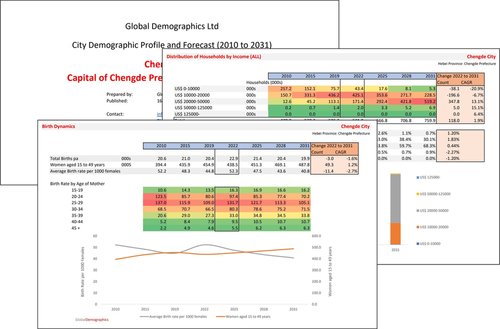
Each city is profiled in a 25-page pdf report with tables and charts for all key variables from 2010 to 2021, actual and projected to 2035.
To learn more about these reports and purchase online
By 2045
The total population of China is projected to decline to 1.378 billion persons – down from 1.411 in 2020 (Census). This assumes the average birth rate per thousand women aged 15 to 49 increases from 44 (in 2019) to 50 in 2024 and then declines to 46 by 2045, reflecting trends in improved education and affluence.
Annual births in 2024 are expected to be 15.7 million and are projected to decline to 12.4 million by 2035 and 11.541 million by 2045.
For more information on births in China, see our Special report on this topic
Learn More